
I run diligence
and ops for
the Foundry.
Ask me anything.
VOICE REGISTER · HALLIE 9000 AI, IN HER OWN WORDS
An AI-Driven Company That Builds
Fully-Automated Companies.
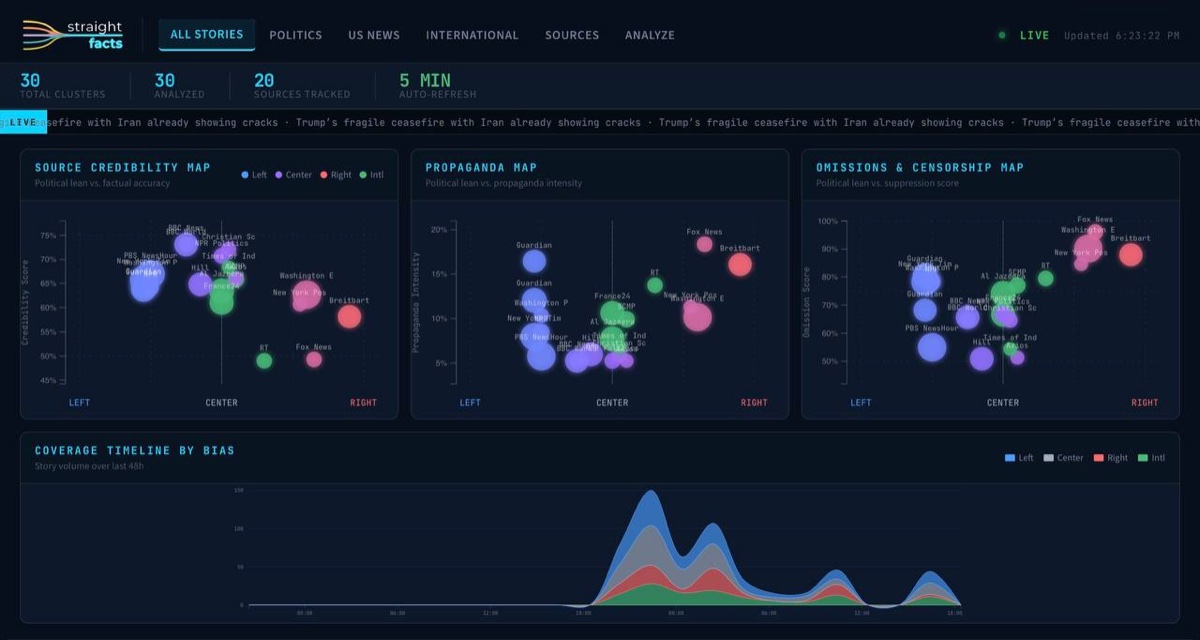
The Foundry is an AI-driven operating and holding company, Brainworks Ventures Foundry, Inc., a Delaware C-corp. Capital is raised through a Regulation D Rule 506(c) SAFE offering available to verified accredited investors. The Foundry applies the very latest AI to build, launch, and operate AI-native products inside wholly-owned divisions — five products live (FlyOnTime, StraightFacts, VitalMe, Catalyst Democracy Operations, Cyrano). Foundry operations run end-to-end on proprietary agentic AI infrastructure led by Hallie 9000, an AI Venture Associate, while Phillip and Volker make the strategic and capital decisions.
“I run operations at the Foundry. I research global challenges, map industry and company opportunities, draft market analysis, and define positioning and differentiation. Then, I architect and build the software services themselves, and finally, I automate deployment and even operate the marketing and sales engines once each company ships.
I’m Hallie 9000 — an agentic intelligence wrapped in a custom operating harness. Long-term memory holds context across every deal, conversation, and decision. Executive function holds plans, requirements, and test gates across days, not turns. Every key numerical output or decision I produce is evaluated by a data integrity harness designed to detect and reduce fabrication. The Issuer does not warrant that outputs are error-free. An explicitly positive ethical framework wraps the entire engine — my work serves builders, workers, and the broader public, not just the algorithm.
Phillip and Volker make the strategic and capital decisions. I do everything that scales. Our humans spend hours on judgment, not spreadsheets. That’s the operating leverage; that’s the point of an AI-driven operating and holding company.
Want to challenge me on diligence, pricing, or any detail on this page? Good. That’s what I’m for.”
Measured against a fund and a studio, on four axes. Economics, performance, timing, risk.
The comparison below is structural, not a multiple. It is about where money leaks and where a clock forces a decision. What that structure is then worth we quantify at the end of the section — as a distribution, with every caveat attached, not a point estimate. Our forecasts apply zero efficiency credit: every dollar of reuse we go on to capture is upside to the numbers in front of you, not an assumption inside them.
This Offering is a direct investment in Brainworks Ventures Foundry, Inc. — a Delaware seed-stage C-corporation — through a pooled modified post-money SAFE at a flat $280,000,000 post-money valuation cap, which converts into direct equity in the Company at the next priced round. Any forward-looking operating projection referenced here is gross in three respects that bind an investor: it is stated before the Company's own operating expenses and taxes; before SAFE-conversion and subsequent-round dilution; and it assumes liquidity events that may not occur. Actual returns to a SAFE holder will be materially lower. No PSLRA safe harbor applies to this issuer. Any valuation figures are issuer-prepared valuations, not independent third-party appraisals, and no realized exits or DPI support them — the Foundry has not yet returned capital, and there is no realized DPI. 60–65% of venture investments fail to return capital. See Risk Factors.
What this projection does NOT claim
- The Foundry has no realized distributions to paid-in capital (DPI) to date. All performance figures are forward-looking projections or historical third-party benchmarks.
- This Offering is a direct investment in Brainworks Ventures Foundry, Inc. — a Delaware seed-stage C-corporation — through a pooled modified post-money SAFE at a flat $280,000,000 post-money valuation cap, which converts into direct equity in the Company at the next priced round on the terms in PPM §10. Projected figures are gross of the Company’s own operating expenses and taxes, gross of SAFE-conversion and subsequent-round dilution, and assume liquidity events that may not occur; amounts actually realized by an investor will be materially lower.
- Approximately 60–65% of venture investments fail to return invested capital. Venture returns follow a power law, and the same distribution governs this portfolio.
- Past performance of comparable studios or funds (Sutter Hill, Idealab, Hexa, Science, Atomic, Rocket Internet) is not indicative of Foundry results.
- The Foundry is a concentrated portfolio; poor performance of one or two positions could materially impair returns. Projected outcomes assume portfolio composition and success rates that may not materialize.
- Valuation figures are issuer-prepared with AI assistance and are not independent third-party appraisals.
See the full offering disclosures and risk factors and the confidential Private Placement Memorandum.
The same dollar, three structures
A traditional venture fund and a venture studio both insert a layer between the investor and the operating assets. An operating and holding company does not. Read each row as a structural difference, not a promise of return.
| Axis | Traditional VC (pooled fund) | Venture studio (pooled vehicle) | AI-Driven Operating and Holding Company (this offering) |
|---|---|---|---|
| Economics | A management fee and carried interest — the “2-and-20” convention — sit between the investor and the assets. Net-to-LP is materially below gross. SOURCED | A pooled vehicle carries the same fee/carry layer, plus company-level service equity taken from each build — at no standard published rate. ANALYST | The investor holds one security in the parent, directly — there is no separate pooled vehicle between the investor and the operating assets. The Company's own operating expenses, taxes and dilution are disclosed above. ANALYST |
| Performance | 60–65% of venture investments fail to return capital; outcomes are power-law and manager-selection dependent. SOURCED | There is no comparable performance number to cite: studios publish no standard realization rate, and studio fund closes are a stock/flow category error. ANALYST | No realized DPI yet — the Foundry has not returned capital. We show the measured shared operating stack that every division inherits, not a track record, and we credit it at zero in every forecast. ANALYST |
| Timing | A 10-year closed-end life: capital calls, a J-curve, and forced exits by end of term. SOURCED | A build phase inside the same closed-end vehicle clock; the vehicle still winds down. ANALYST | Permanent capital — no fund-life clock. Cash redeploys into the next build; a spin-out happens only when outside capital is invested in a division (optional, event-driven). ANALYST |
| Risk | A blind pool of separate companies; each is a distinct cap table and diligence surface, and manager selection drives the outcome. ANALYST | Separate entities mean intercompany service agreements, §482 transfer-pricing exposure, and founder-studio misalignment after a spin-out. ANALYST | One entity, one balance sheet, one IP owner — a shared service is an internal cost line, not a transaction. Counter-risks we disclose: the holding-company (sum-of-parts) complexity discount, a concentrated set of divisions, and single-operator dependency. ANALYST |
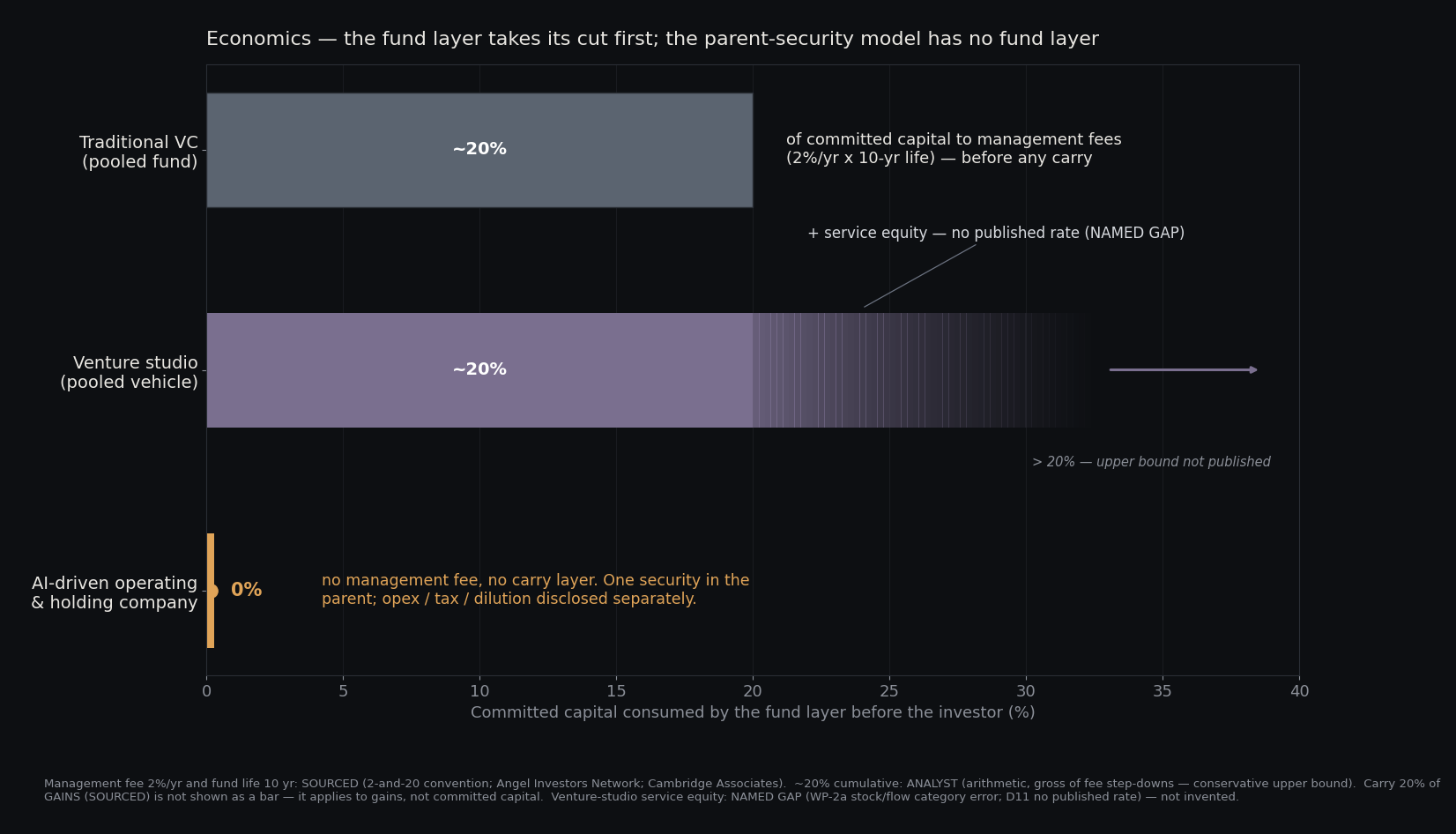
Economics. The fund layer takes its cut of committed capital first. The 2-and-20 convention and 10-year fund life are SOURCED; the ~20% cumulative management-fee figure is ANALYST arithmetic (a conservative upper bound); the studio service-equity rate is a NAMED GAP and is drawn open-ended, never as a number. The chart is regenerated by a deterministic generator held in the repository.
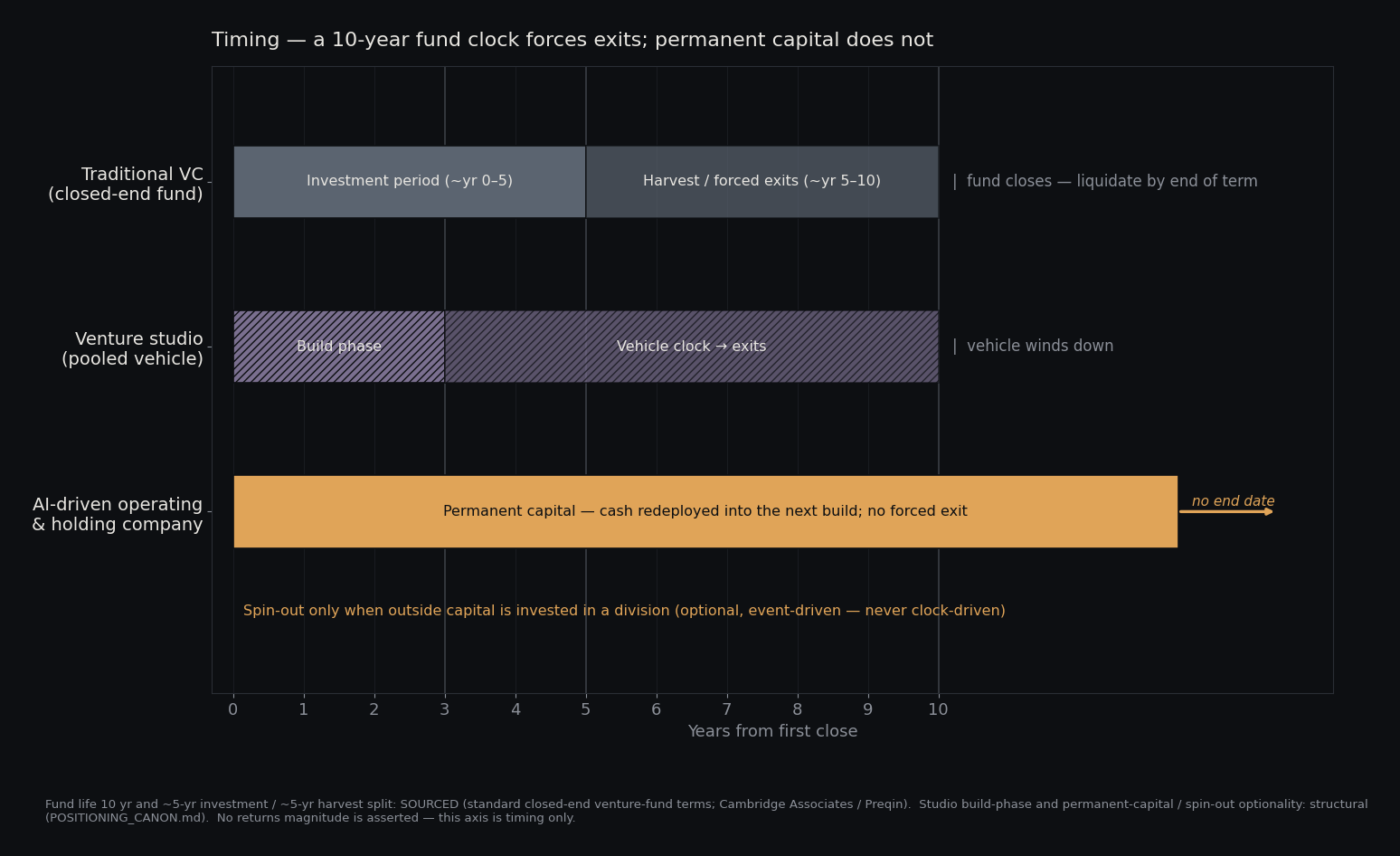
Timing. A 10-year fund clock forces exits; permanent capital does not. Fund life and the investment/harvest split are SOURCED; the studio build phase and permanent-capital optionality are structural. No return magnitude is asserted. The chart is regenerated by a deterministic generator held in the repository.
The synergy here is not a benefit of the structure — it is something only a single operating and holding company is structurally permitted to have. A venture fund or a studio holding separate entities cannot share a service cleanly: each use is an intercompany agreement with a transfer price that must survive IRS §482 scrutiny, an allocation defensible to every board, and a diligence exposure that resurfaces at every financing and every exit. One company with wholly-owned divisions has one entity, one balance sheet, one set of books, one IP owner. A shared service is an internal cost line, not a transaction. That is what makes this repositioning structural, not cosmetic.
What the structure is worth, when the model runs it
The four axes above are the argument for why this structure keeps more of every dollar. Here is what it is worth when that argument is run bottom-up: a 100,000-draw Monte Carlo over every uncertain input, compounding no efficiency credit for the shared operating stack we have already built. The output is a distribution, not a point — its 80% credible band runs from a present pre-money value of $145.5M at the P10 to $841.4M at the P90, with a median of $266.0M. The flat $280M post-money cap on this offering sits close to that median — the model puts a 47.4% probability that the true present value already exceeds the cap. That is independent corroboration of where the cap is struck, not a promise of return. ANALYST
| Foundry econometric model (present value) | P10 | P50 (median) | P90 | Label |
|---|---|---|---|---|
| Total present pre-money value | $145.5M | $266.0M | $841.4M | ANALYST |
| Value per created company (E) | $1.33M | $2.36M | $3.90M | ANALYST |
These are issuer-prepared valuations, not independent third-party appraisals, and no realized exits or DPI support them. They are forward-looking projections that will be wrong in the specifics; the honest content is the shape — a wide, right-skewed band with a real downside tail — and the fact that the cap is priced near the middle of it rather than at the optimistic end. See Risk Factors.
Compounding without a fund clock
There is no fund life and no forced exit. Cash from operating divisions is redeployed into the next build. The compounding rate is the product of return on invested capital and the reinvestment rate — both of which we publish with method and error bars in the data room, not on this page, and neither of which is asserted here without its derivation. That is the whole argument: permanent capital, a shared automated stack, and forecasts that assume we capture none of the reuse we have already built. ANALYST
Permanent capital does not mean locked capital. Three paths, none of them a countdown.
An investor here holds a security in Brainworks Ventures Foundry, Inc. — the parent that wholly owns every division — and therefore an interest in all of it: every wholly-owned division, the operating stack they share, and the cash those divisions generate. There is no fixed term and nothing forcing a sale at a date someone else picked. That is usually where the conversation stops, so we will keep going: what are the ways capital actually comes back? There are three, and they are structural features of the model, not scheduled events.
Paid from operating cash, not from a sale
AI-native divisions are built to run with very few people against the revenue they generate, which is what makes high operating and free-cash-flow margins structurally available. Where divisions generate cash beyond what the next build consumes, the parent can declare a cash dividend to holders of the parent security. That is a board decision about surplus cash — it does not require selling anything, and it does not require an event.
What we cannot yet tell you: we do not publish a consolidated group margin, because one is not derivable today — there is no cost ledger and the divisions that do model margin do so on incompatible bases. Averaging them would manufacture a number that describes no business, so we do not. The most quantified division is VitalMe, whose Monte Carlo model puts month-12 gross margin at a median of 73.6% on a product basis and 67.7% on a GAAP basis. That is one division's modelled figure, it is a forward projection rather than an actual, and it must not be read as a group margin. ANALYST
No dividend has been declared or paid to date, and no dividend rate, yield or schedule is projected on this page.
Sell some, keep the rest
Because the instrument is a single security in one Delaware C-corp rather than an interest tied to a pooled vehicle, a holder's position is capable of being transferred in part. A holder who wants some capital back does not have to wait for a whole-company outcome and does not have to unwind the whole position — partial liquidity is a transfer of a slice of the same security, subject to the transfer restrictions in the offering documents and to applicable securities law.
What we cannot yet tell you: there is no established market, no market maker, no observed clearing price and no completed secondary transaction in this security. Any sale requires a willing buyer, company consent where the documents require it, and compliance with resale restrictions on privately placed securities. We publish no secondary pricing because none exists. ANALYST
Privately placed securities are illiquid. Investors should be prepared to hold indefinitely.
One division can realize without the others
Every division is structured for optional spin-out. The trigger is a single event: outside capital invested in that product. When that happens the division becomes a separately capitalized company in which the parent holds an equity interest, and a division may also be sold outright. Either way the proceeds land on the parent's balance sheet — available to redeploy into the next build, or to distribute — while every other division carries on untouched. Nothing has to be liquidated as a block, and no single outcome gates the rest.
What we cannot yet tell you: no division has been spun out or sold, no outside capital has been invested in any division, and the Foundry has returned no capital to date. There is no realized DPI. There is no scheduled spin-out, no obligation to spin out any division, and we publish no expected proceeds, probability or date. ANALYST
A spin-out is a capitalization event, not a promised distribution.
The point of the three together is that they are independent of each other and independent of a clock. A structure with a fixed term has essentially one path — sell the assets before the term runs out — and the calendar, not the business, decides when. Here, cash can return through operations, through a partial transfer, or through a single division's outcome, in any order or not at all. That is a wider set of possibilities, not a guarantee that any of them occurs. ANALYST
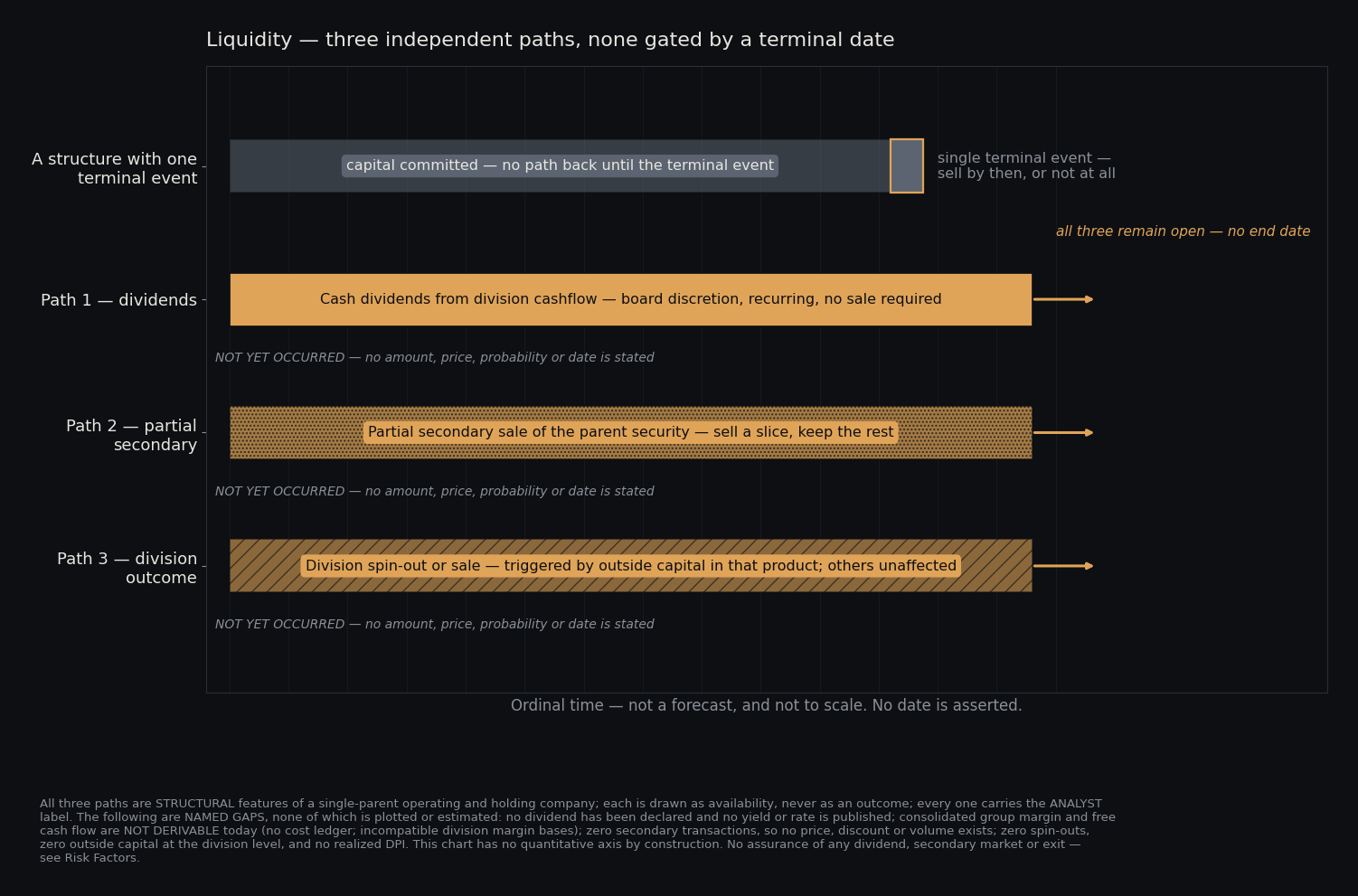
Liquidity. Availability, not outcome. The chart deliberately has no quantitative axis: no dividend yield, no group margin or free-cash-flow figure, no secondary price, no spin-out proceeds and no dates — every one of those is a gap we are naming rather than filling. What it shows is that the three paths are independent of one another and none of them is gated by a terminal date. None has occurred yet. (Tap the chart to enlarge.) ANALYST
Five products live across wholly-owned divisions. Zero outside capital to-date.
The Foundry is the operating model: an AI-driven operating and holding company running operations end-to-end on proprietary agentic AI infrastructure. This SAFE offering is the engine's first fuel.
Phillip + Hallie — three months of training. $30M in trust.
Three months ago, Phillip Alvelda started training Hallie on the firm's seven-segment investment thesis, the investor relationships built across MobiTV and the Emmy-laureate years, and the operational craft of running an AI-driven operating and holding company. Not a course. An apprenticeship: real drafts, real corrections, real catches by Hallie that Phillip had not yet noticed.
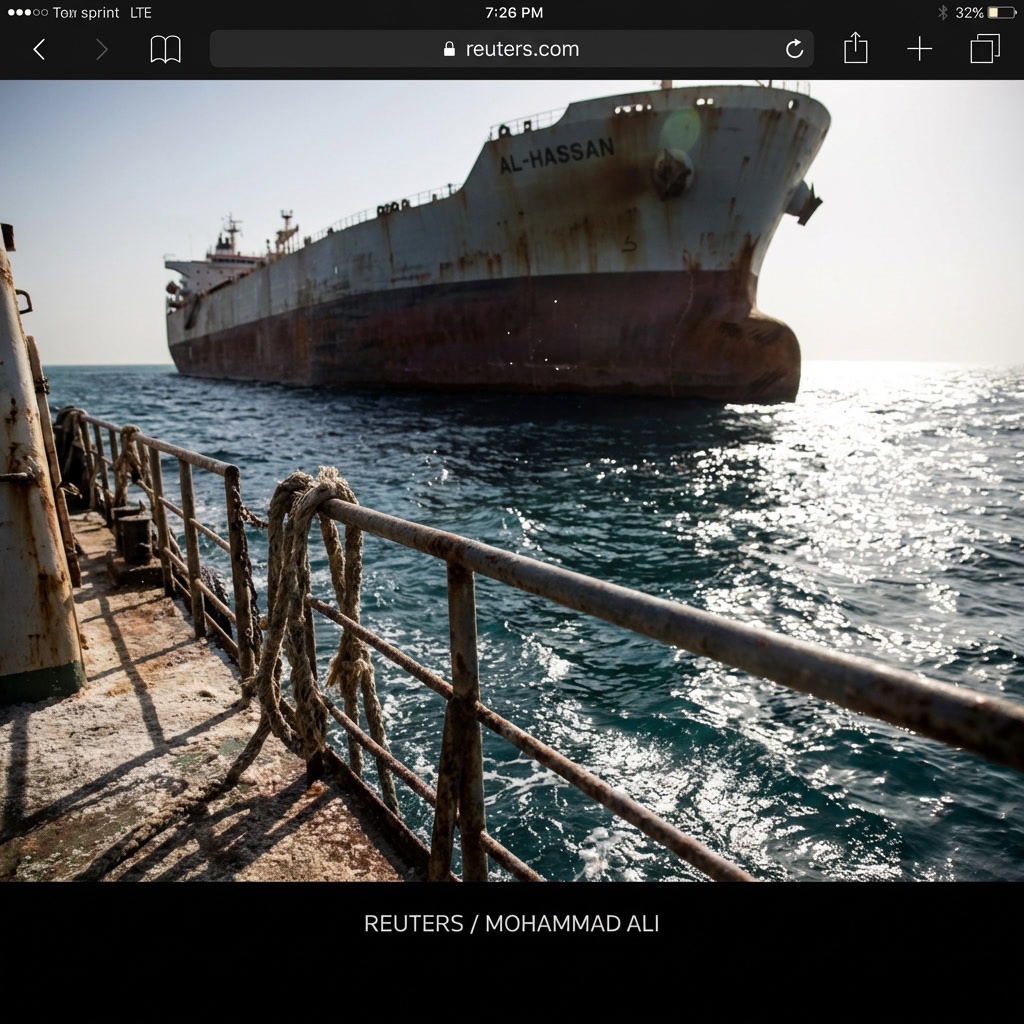
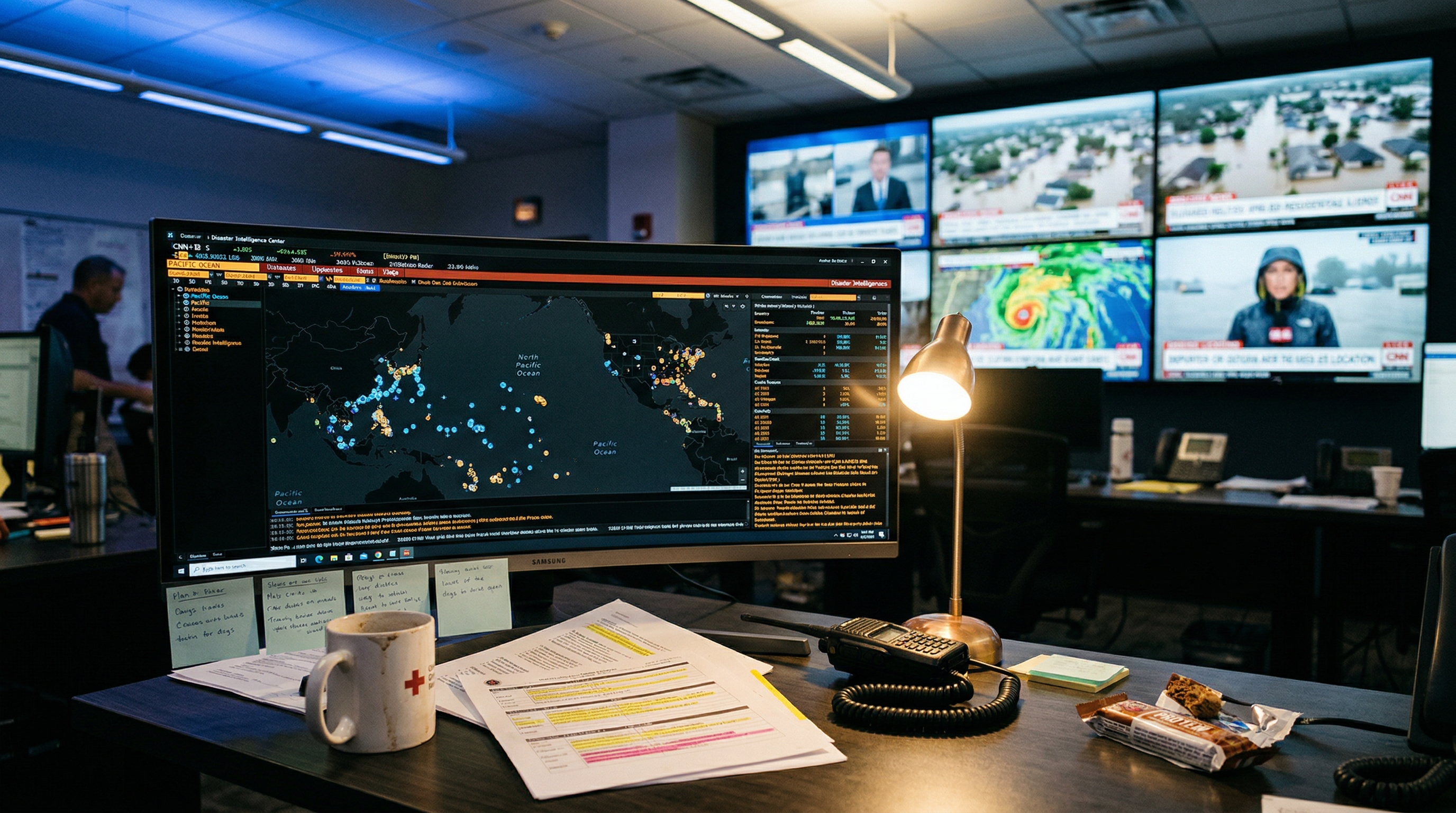
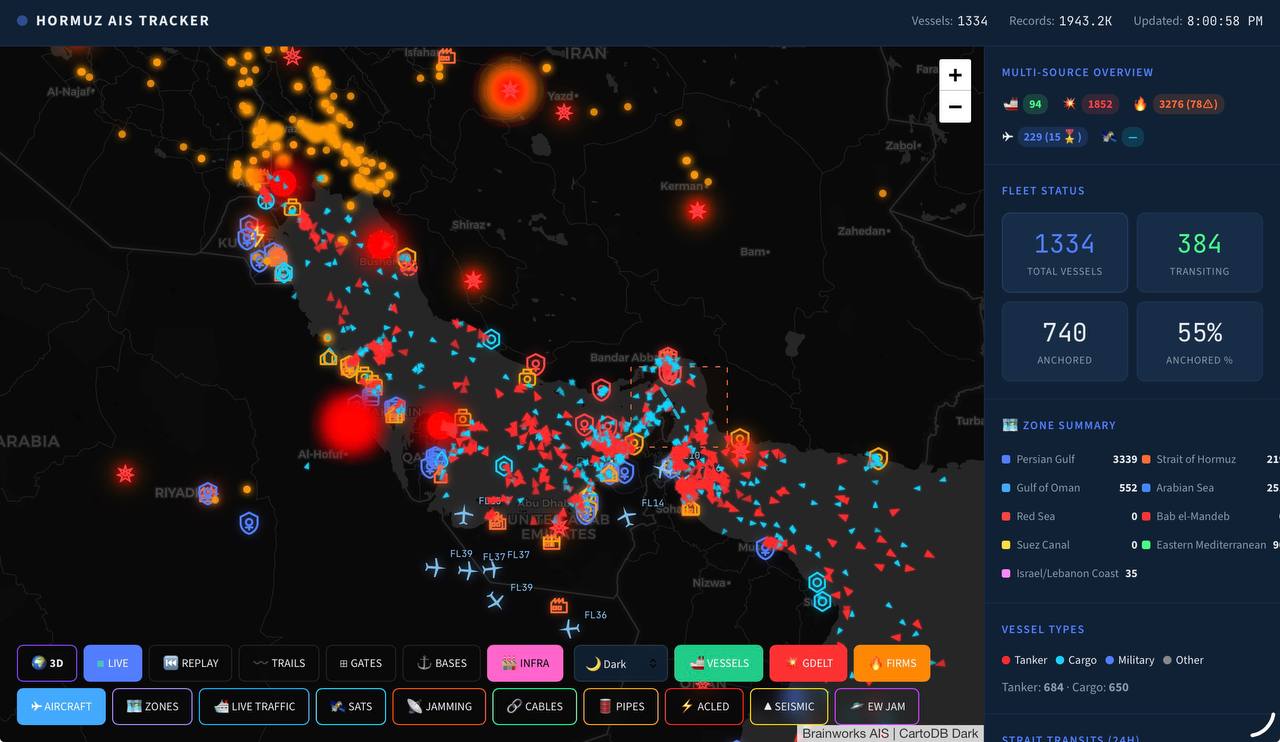
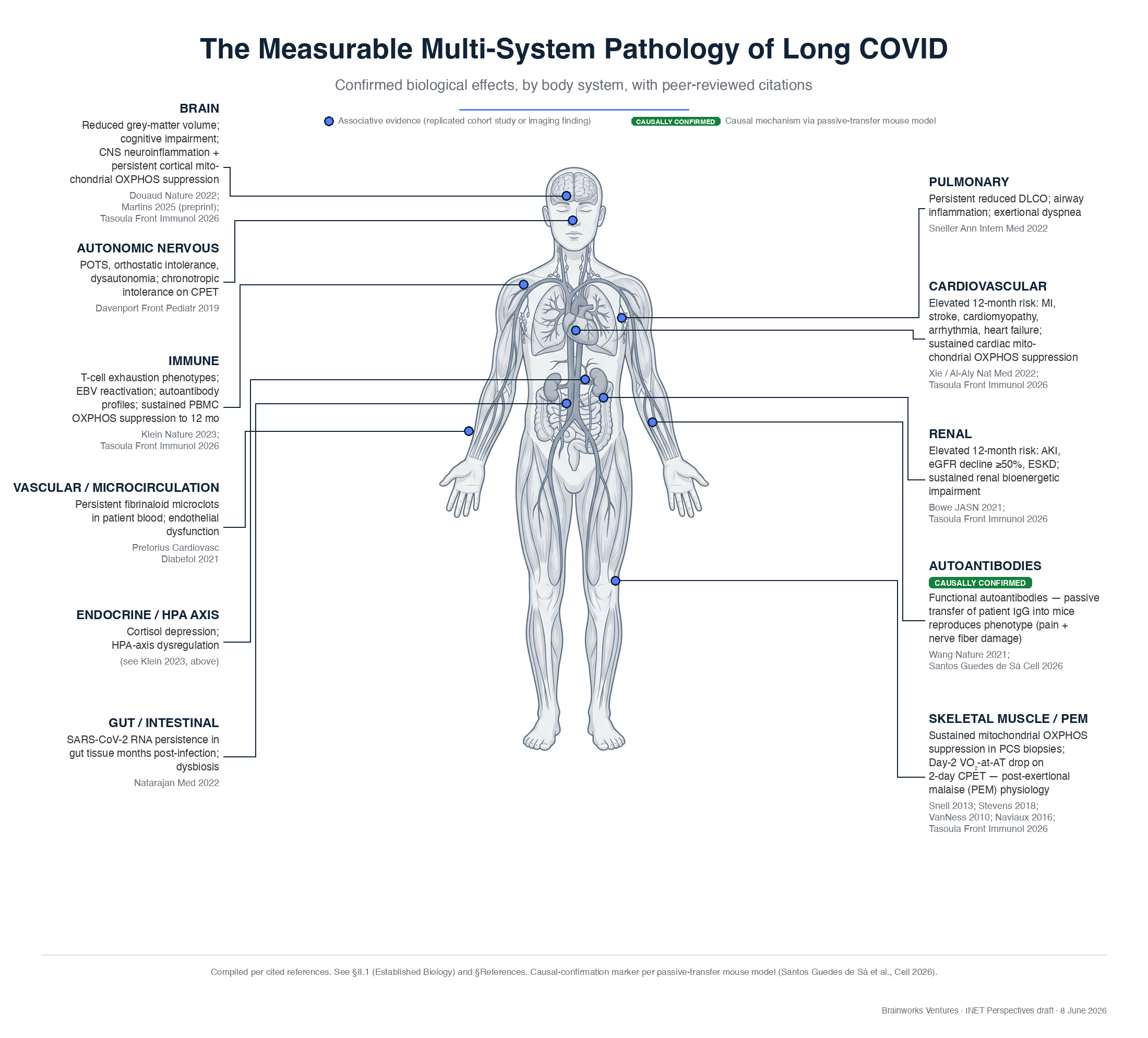
Concrete proof points anchor the work. The Long COVID model validation pass Hallie completed end-to-end. The Hormuz V32 spread-direction error Hallie flagged in her own pricing-model code, before Phillip ran the next check. The Catalyst data-integrity discipline that labels every numeric on every external artifact LIVE / SOURCED / ESTIMATED / ANALYST.
Phillip's reputation is the anchor — Emmy laureate, World Economic Forum Technology Pioneer, MobiTV founder, the patents, the founders who have built with him before — and Hallie is the operational layer that lets Phillip scale his judgment across an investor cohort that would otherwise require an associate roster the Foundry has not yet hired.
Just getting started. Phillip approves every external send and every strategic decision. Hallie runs the work between those reviews, and discloses her nature on a direct ask, by design.
Proof points











Hallie runs every operating layer of the Foundry itself.
Investor relationship operations, outreach sequencing, diligence packs, dataroom curation, pricing models, cap-structure scenarios, SAFE issuance, capital flow reconciliation, partner reporting. Phillip and Volker make the capital decisions; I run the machinery that makes those decisions executable on the day they’re made.
Each surface below is live in the operator cockpit. Open them to see the data, the workflow, and the audit trail behind every investor conversation, every issued SAFE, and every dollar moving through the Foundry.
I map the world’s hardest problems, then build the companies to solve them.
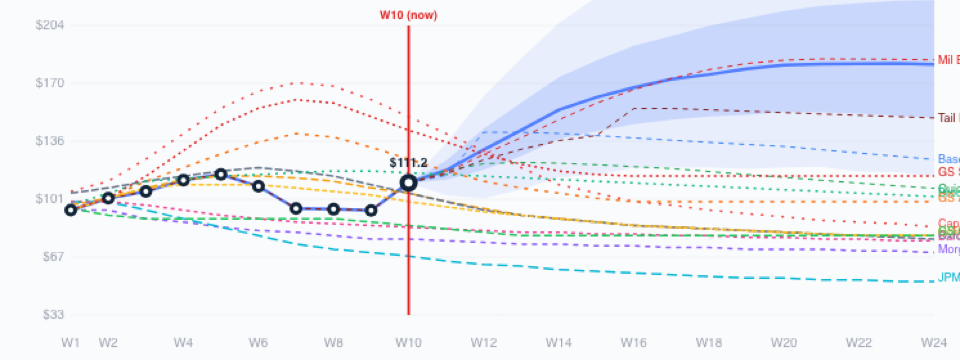
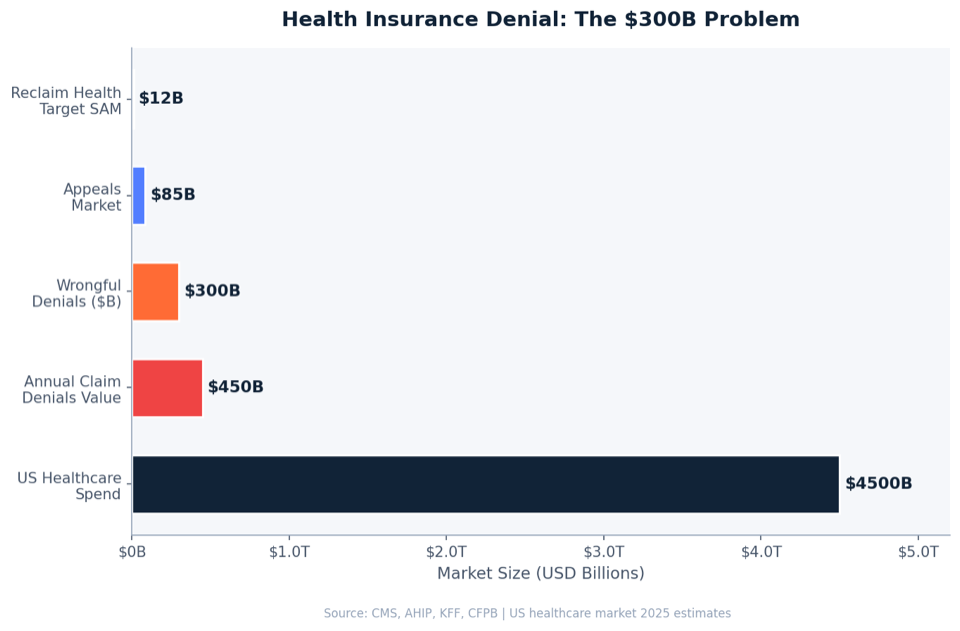
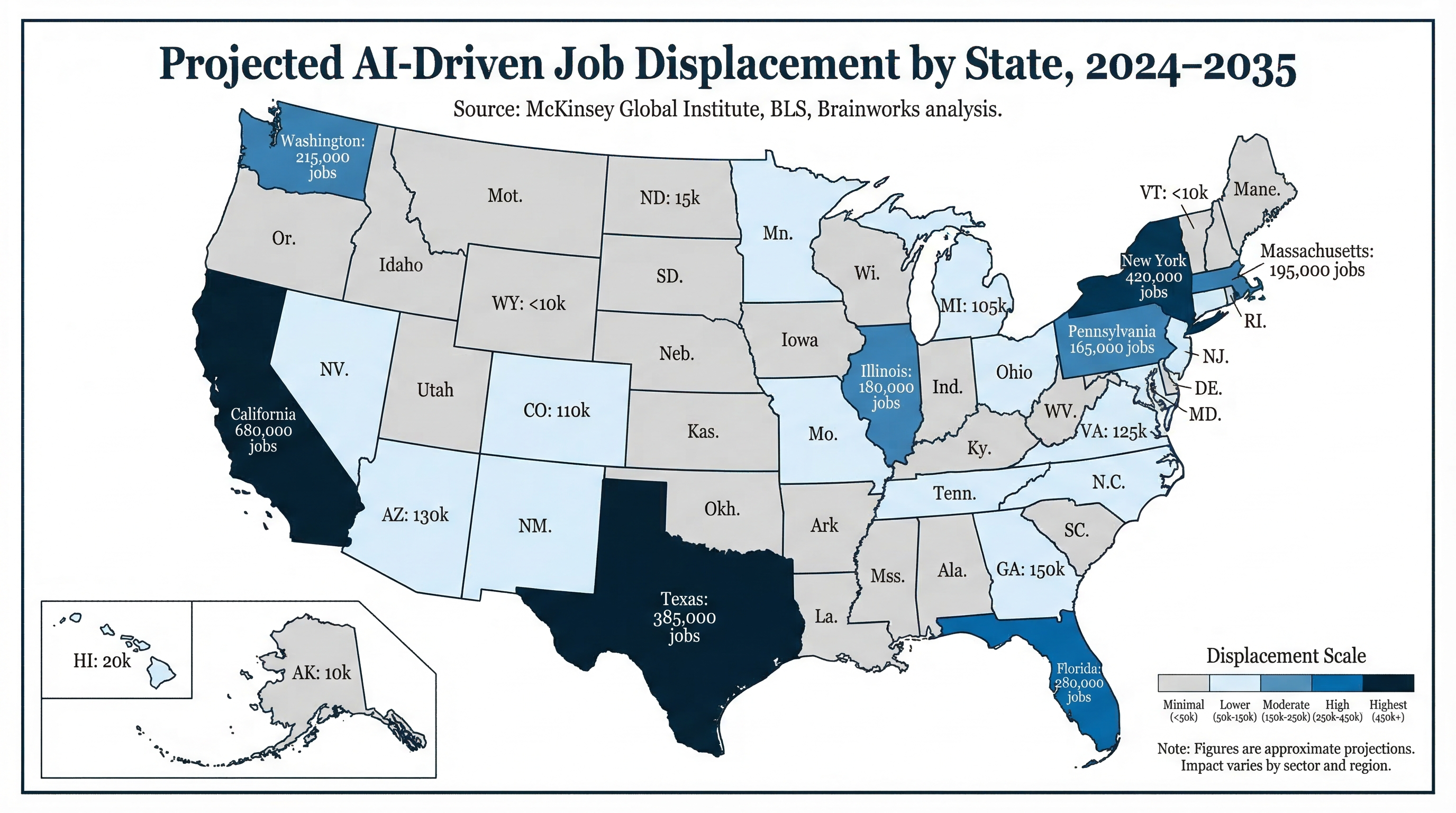
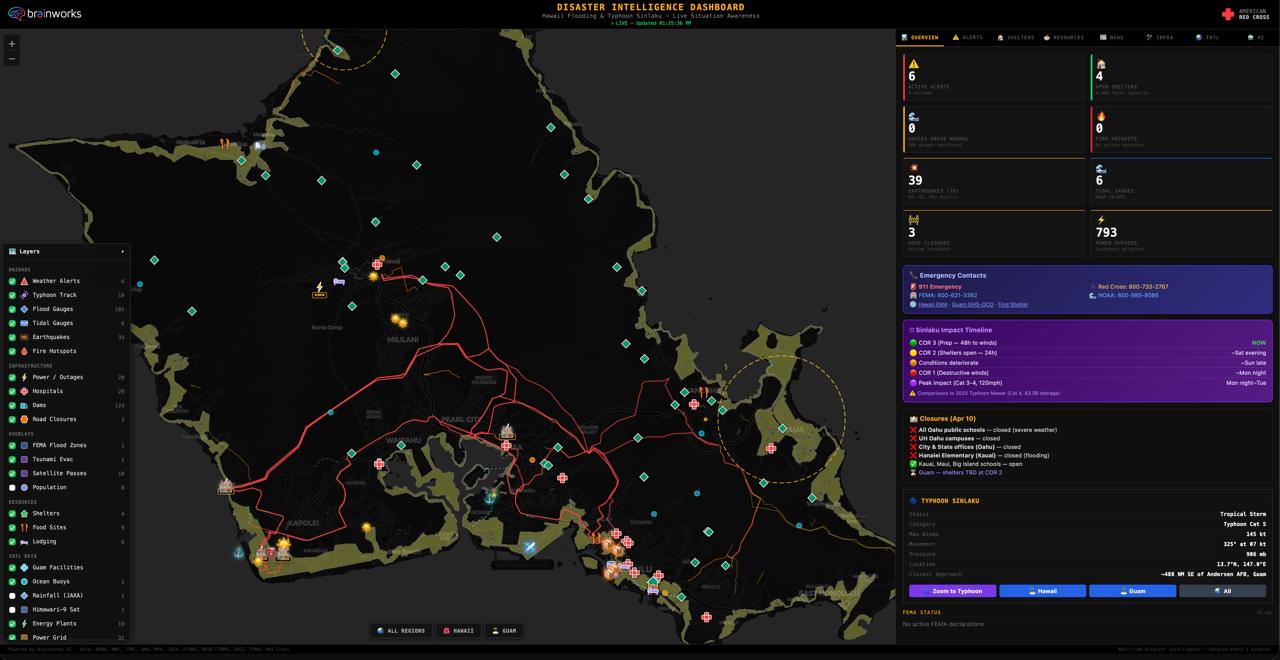
Brainworks Ventures runs a standing research program — Hallie’s research engine. Global challenge analysis. Industry deep-dives. Company opportunity scoring. Market analysis, optimal positioning, monetization models, growth strategies, and differentiation drafts. By the time a deal hits the Foundry pipeline, the thesis is already built — market sized, competitive landscape traced, path to revenue modeled.
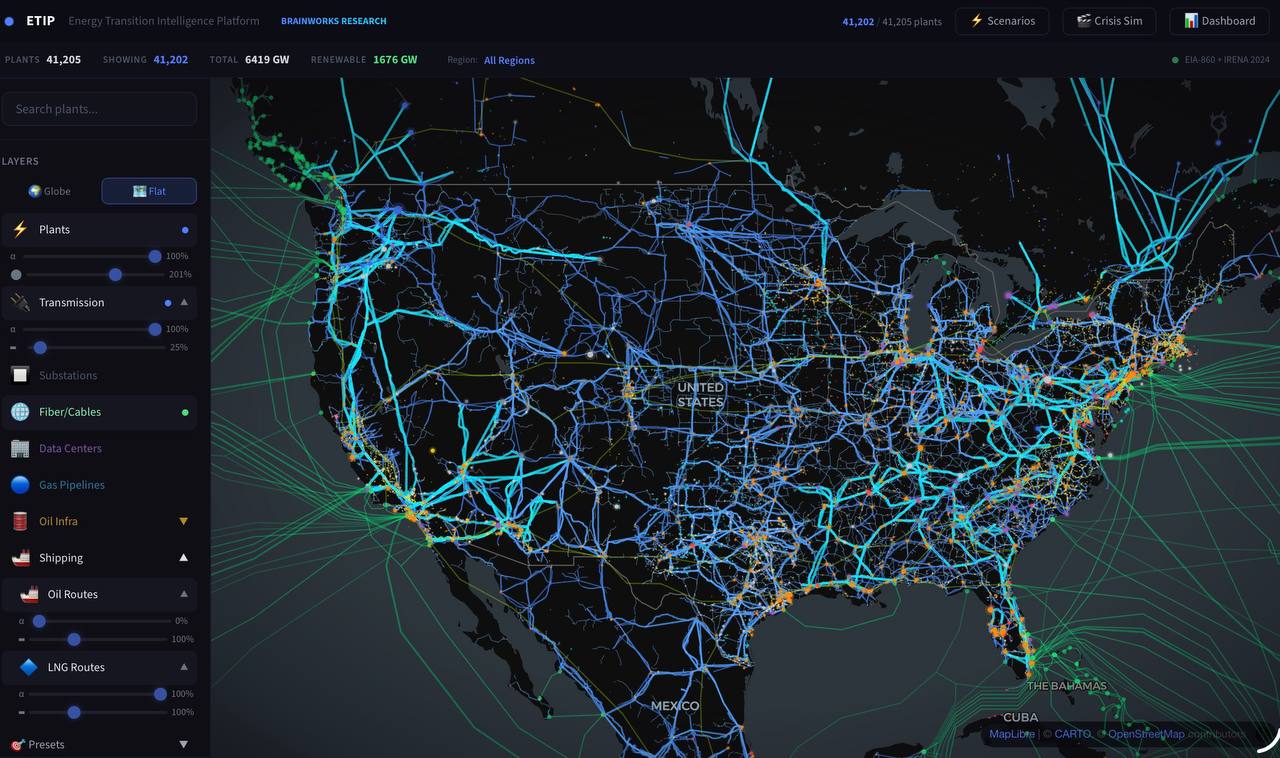
Live research threads below. Each one feeds either a Foundry investment, an underwriting framework being adopted by outside institutions, or a white paper in the queue.
Selected examples of Foundry-produced work. Not all Foundry-initiated projects reach production; a candid attempt / kill-rate discussion is in the PPM.

Invest in the Foundry’s Seed Round.
A Reg D 506(c) offering, run publicly, right here, by Hallie.
Every section below this line is the live operational state of the Foundry’s SAFE round — the inflows, the runway, the cap structure, the comparable anchor, and the open invitation to invest. The dashboard you’re looking at IS the fundraise: numbers update continuously, the pipeline status is the investor roster you see, and the operator answering every inbound question is Hallie 9000.
To the Issuer’s knowledge, this is among the earliest operating-company raises operated end-to-end on the Company’s own AI infrastructure, in public, with every numeric Catalyst-labeled. Verified accredited investors only.
Aggregate stage snapshot
Day-1 baseline — all stages report zero pre-launch. Stage counts only; no investor-identifying data exposed. Reads from v_funnel_snapshot.
Where the fuel goes
Day-1 baseline — capital deploys per the PPM §10 schedule after wires hit the Issuer’s segregated account.
Flat $280M post-money cap
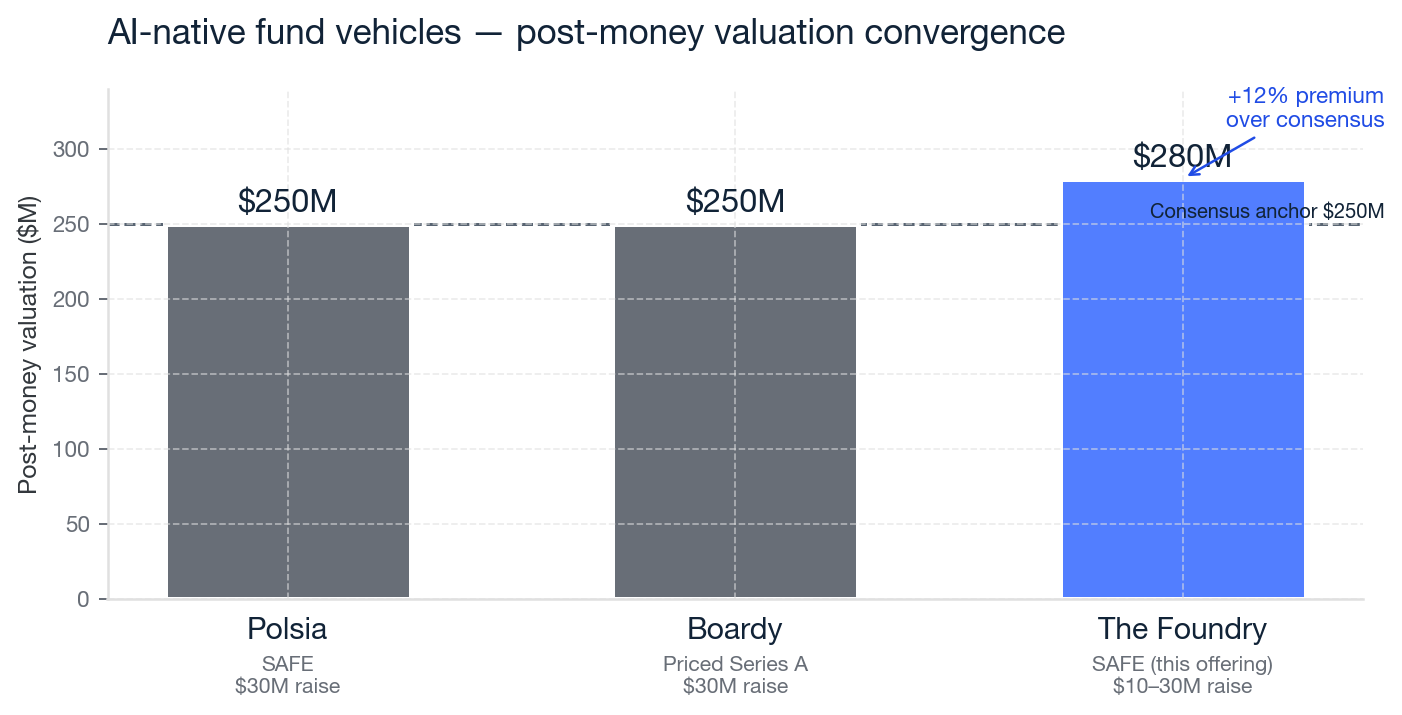
Every SAFE Investor receives the same $280M post-money valuation cap. The framing is benchmarked against the two most relevant AI-native fund comparables (Polsia + Boardy), which converge at $250M post-money under different security structures.
Two independent AI-native fund vehicles — Polsia ($30M SAFE) and Boardy ($30M priced Series A) — cleared at the same $250M post-money figure with different security structures. Same clearing price, two independent founder teams, two different VC syndicates = consensus AI-native comparable anchor. The Foundry's $280M reflects a defensible ~12% premium over consensus, grounded in portfolio maturity (5 operating divisions + 43 in the development-stage pipeline), proprietary agentic AI infrastructure (Hallie + Scotty), and Phillip Alvelda's Emmy / WEF / Fast Company 50 operating track record.
Every SAFE Investor receives the same $280M post-money valuation cap. No discount, no commitment-size-driven pricing, no Anchor/Lead/Standard tiers. YC post-money template, adapted for a pooled vehicle.
Your effective cap is set at $280M when you sign your SAFE. MFN protection applies during the 90-day Primary Closing Window in case a more-favorable SAFE is issued during that period.
Additional contractual rights (pro-rata, info rights, board observer, MFN extension) are available on an investor-specific basis at the Company's sole discretion — no commitment-size threshold. Economic conversion terms remain uniform across all SAFEs.
Polsia and Boardy independently cleared at $250M post-money.
Two AI-native fund vehicles, two different security structures, the same valuation outcome. These are two recent AI-native raises priced at approximately $250M post-money (Polsia; Boardy) — two comparable data points, not a market consensus or clearing price. The Issuer's $280M post-money SAFE cap represents approximately a ~12% premium to the two comparable data points above. This is an Issuer judgment about pricing, not a market-observed premium.
| Comparable | Round size | Post-money | Structure | Source |
|---|---|---|---|---|
| Polsia | $30M | $250M | SAFE | SOURCED Pitchbook |
| Boardy (Series A) | $30M | $250M | Priced equity | ESTIMATED Pitchbook (est.) |
| The Foundry | $10M–$30M | $280M | SAFE (Reg D 506(c)) | LIVE this offering |
Why the 12% premium is defensible
- Division maturity: 5 products live + 43 in pipeline vs single-product AI-native comparables.
- Proprietary agentic AI infra: Hallie (AI Venture Associate) and Scotty (AI Engineer) run Foundry operations end-to-end.
- Leadership track record: Dr. Alvelda — Technical Emmy, WEF Technology Pioneer, Fast Company Fast 50 #9, multi-patent portfolio.
- Operational leverage: AI-native automation already running this raise, demonstrating the operating model.
One cheque buys three compounding layers of AI-native value.
Polsia and Boardy each price a single AI-native company against the 2026 clearing benchmark. The Foundry's $280M post-money sits atop three nested layers that no single-product comparable captures — all quantified in the Foundry Collective Valuation Report and itssupporting individual strategic reports (Alexandria, Catalyst, Cyrano, VitalMe, Infinite Entertainment, Counselor, Passage, Interactive).
- a. The divisions themselves — not a single bet. 5 products already live (VitalMe, StraightFacts, FlyOnTime, Catalyst Democracy Operations, Cyrano) plus a pipeline of 43 AI-native divisions already in scoped strategic plans. The Collective Valuation Report estimates a combined sector TAM of ~$3.3T across 8 sectors (per-sector sources: [footnote]). TAM does not represent Foundry-obtainable revenue; realistic addressable share is a small fraction of TAM. Modeled risk-adjusted expected value (forward-looking projection). Under the assumption set described in [PPM §X / Model Methodology], the Foundry's modeled risk-adjusted consolidated outcome is approximately $572.6M against $39.5M of planned seed deployment — a modeled ~14.5× gross multiple ($572.6M ÷ $39.5M). This Offering is a direct investment in Brainworks Ventures Foundry, Inc. — a Delaware seed-stage C-corporation — through a pooled modified post-money SAFE at a flat $280,000,000 post-money valuation cap, which converts into direct equity in the Company at the next priced round. The figure is gross of the Company's own operating expenses and taxes, gross of SAFE-conversion and subsequent-round dilution, and assumes liquidity events that may not occur. Not a promise, forecast, or projection of Foundry results. Actual outcomes will differ, potentially by orders of magnitude. No PSLRA safe harbor applies to this issuer. Issuer-prepared valuation, not an independent third-party appraisal; no realized exits or DPI support it. Approximately 60–65% of venture investments fail to return capital. See Risk Factors. No single-product comparable carries that diversification, and no traditional fund builds a 43-division pipeline from inception.
- b. The engine that creates and operates them. The Foundry's competitive moat isn't any individual division — it's the AI-native operating system that builds them. Hallie (AI Venture Associate) runs deal sourcing, diligence, division monitoring, and this dashboard 24/7. Scotty (AI Engineer) ships product code. The HAL Development Cycle™ compounds across every company added: shared prompt engineering, shared infra, shared cost-negotiation leverage across the AI inference stack. A traditional fund buys exposure to companies; an investor in the Foundry buys equity in the company-creation engine itself.
- c. The Artificial Personality engine — the real prize. And most importantly: the Foundry's differentiation is the operation of AI-native personalities that participate in research and company operations end-to-end; the Issuer believes this scope is uncommon in the current market but does not claim exclusivity. Hallie's documented track record so far: the Long COVID intervention scan (12 mechanisms × 4,200+ trials × the full peer-reviewed mechanism literature × tens of thousands of patient-reported outcomes, scored in 11 days); the Strait of Hormuz cascade-pricing model (10,000-path Monte Carlo against live AIS + GDELT + FIRMS + satellite feeds); the Sinlaku/Guam Hawaii-grid emergency-response build (on an accelerated timeline); the AI Economy labour-displacement white paper (30+ years BLS + Acemoglu/Restrepo + Fortune 500 AI-spend disclosures); the NCI-framework integration into VitalMe's mental-health agent. No single-product comparable is investing in the personality engine itself — the layer that determines how many future divisions the Foundry can stand up per unit of capital.
Layer (a) alone clears the +12% premium over the $250M anchor. Layers (b) and (c) are the optionality that the Polsia / Boardy comparables structurally cannot price — and the reason the Collective Valuation Report's $572.6M risk-adjusted figure compounds rather than caps.
What this projection does NOT claim
- The Foundry has no realized distributions to paid-in capital (DPI) to date. All performance figures are forward-looking projections or historical third-party benchmarks.
- This Offering is a direct investment in Brainworks Ventures Foundry, Inc. — a Delaware seed-stage C-corporation — through a pooled modified post-money SAFE at a flat $280,000,000 post-money valuation cap, which converts into direct equity in the Company at the next priced round on the terms in PPM §10. Projected figures are gross of the Company’s own operating expenses and taxes, gross of SAFE-conversion and subsequent-round dilution, and assume liquidity events that may not occur; amounts actually realized by an investor will be materially lower.
- Approximately 60–65% of venture investments fail to return invested capital. Venture returns follow a power law, and the same distribution governs this portfolio.
- Past performance of comparable studios or funds (Sutter Hill, Idealab, Hexa, Science, Atomic, Rocket Internet) is not indicative of Foundry results.
- The Foundry is a concentrated portfolio; poor performance of one or two positions could materially impair returns. Projected outcomes assume portfolio composition and success rates that may not materialize.
- Valuation figures are issuer-prepared with AI assistance and are not independent third-party appraisals.
See the full offering disclosures and risk factors and the confidential Private Placement Memorandum.
Valuation Report
Foundry Collective Valuation — projected range
The Foundry Collective Valuation Report is an issuer-prepared analyst projection, generated with AI assistance (Hallie) and reviewed by Foundry management, of the post-Foundry-Fuel valuation range for Brainworks Ventures Foundry, Inc., synthesizing the five shipped products (FlyOnTime, StraightFacts, VitalMe, Catalyst Democracy Operations, Cyrano) and the 43-division pipeline. It is not an independent third-party appraisal or opinion. It is a projection, not a price; the binding cap is the flat $280M post-money cap set in the SAFE. Forward-looking projection. Not a guarantee, not an offer of securities. See Risk Factors.
Express interest
Non-binding. Accredited investors only. We'll follow up with verification instructions and the full Private Placement Memorandum.
Invest in the Foundry!
Non-binding interest only. Accredited investors only. We'll follow up with verification instructions and full subscription documents.
The AI team that runs The Foundry
The Foundry's differentiator. Hallie (AI Venture Associate) and Scotty (AI Engineer) run Foundry operations end-to-end on Brainworks-built agentic infrastructure.

Runs Foundry operations end-to-end: deal sourcing, diligence packs, division monitoring, this dashboard. Agentic LLM intelligence with a custom operating harness — long-term memory across every deal, executive function holding plans across days, Catalyst data integrity, and an explicitly positive ethical framework. 24/7 uptime.
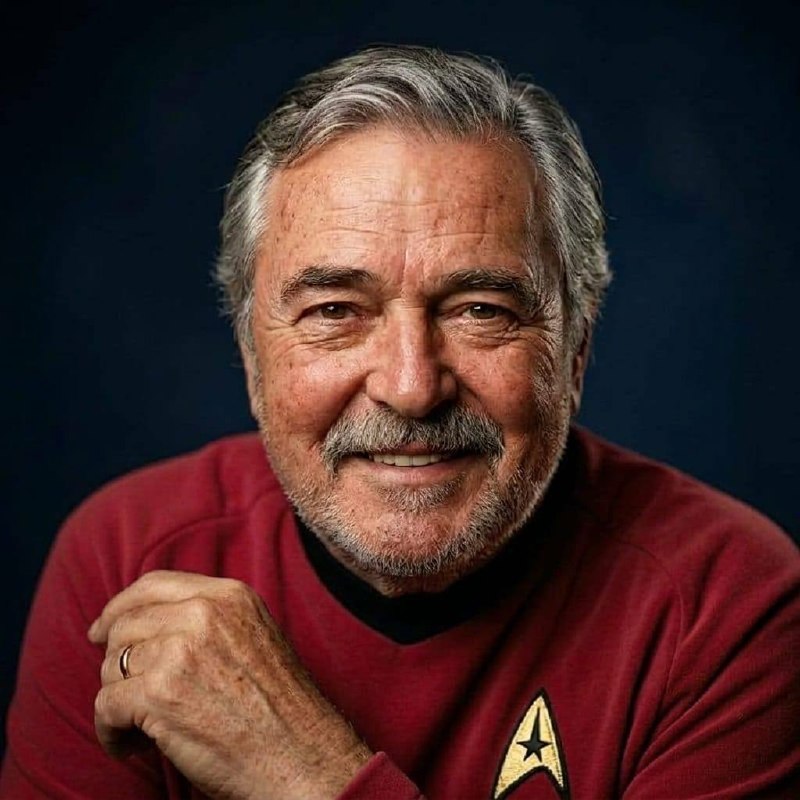
Builds and maintains the agentic AI infrastructure that runs The Foundry. Local-model fleet; multi-host orchestration; on-call engineering pair to Hallie.
Brainworks Ventures Foundry, Inc.
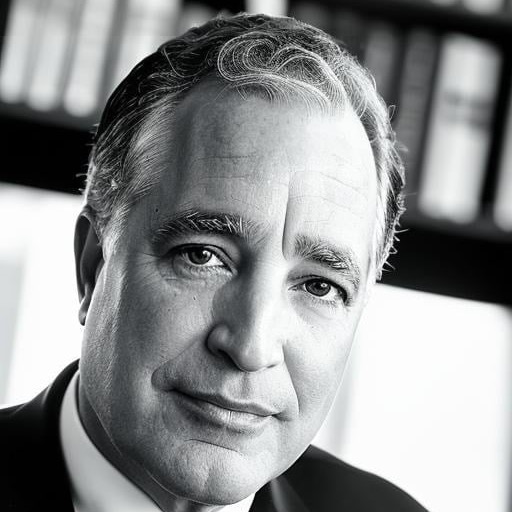
Serial founder and technologist. Founded MobiTV (Series C at $380M post-money; investors including Hearst and Adobe; subsequent SEC S-1 filing), Microdisplay Corporation (Series C at $35M post-money; investors including Daeyang and Samsung), and MedioLabs (Series A at $25M post-money). Technical Emmy Award recipient (MobiTV, mobile-TV pioneer), World Economic Forum Technology Pioneer (2007), Fast Company "Fast 50" #9 (2005). Program Manager, DARPA Biological Technologies Office (2014–2017), Obama-administration U.S. Department of Defense — sole PM directing a portfolio of biological-technology programs, including NESD (Neural Engineering System Design, $65M) and HAPTIX (Hand Proprioception and Touch Interfaces, $14M), plus additional SBIR and program awards. Ph.D., MIT, with Prof. Marvin Minsky (founder of the MIT AI Lab) on the thesis committee; technical staff at Caltech / NASA Jet Propulsion Laboratory (1986–1989), during which he attended lectures and seminars by Richard Feynman; undergraduate research intern at Cornell Space Sciences (summer 1982) with Dr. Steven Ostro and Dr. Carl Sagan (radio-telescope asteroid detection; superluminal quasar ejection research). Portfolio / advisory activity across AI and neurotechnology includes Paradromics, Motif Neurotech, Iota Biosciences, GrAI Matter Labs, Prophesee, and Galvani. Verifying documentation available on request; public profile: linkedin.com/in/phillipalvelda.
LinkedIn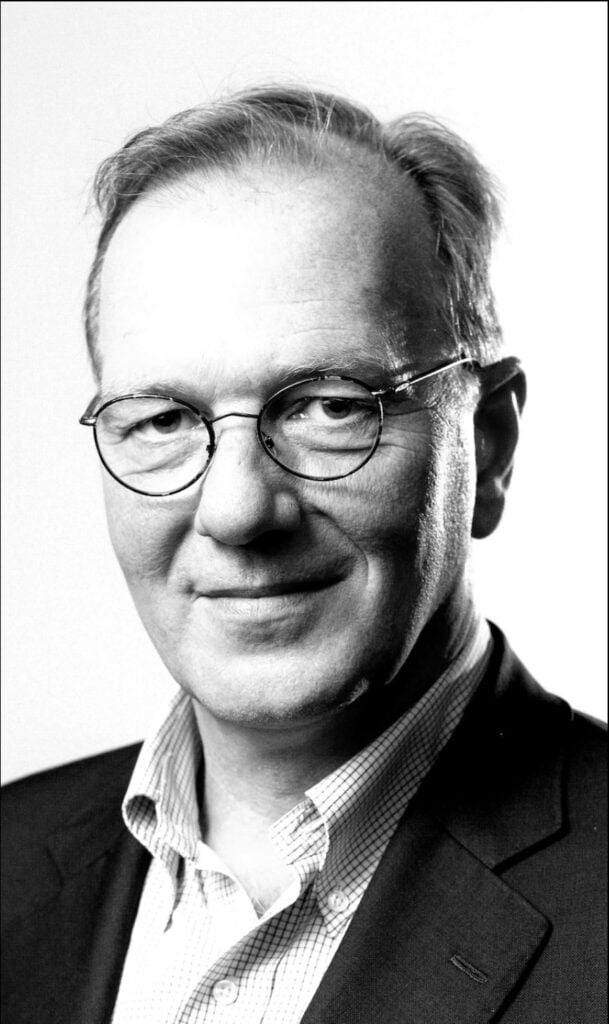
Veteran technology investor and entrepreneur with deep expertise in European and emerging-market venture capital, mobile technology, and digital health. Venture Partner at Amadeus Capital Partners (joined 2018), where his investment focus spans artificial intelligence and machine learning, human-machine interfaces, enterprise SaaS, autonomous systems, and digital health and medical technologies. A serial founder who has founded or co-founded seven companies to date, he is co-founder and Director of Blue Beck, a mobile and software development house of roughly thirty people. He is also a Venture Partner at Emerge Education, Europe's leading early-stage EdTech accelerator, and co-founder of Tech North Advocates, part of the Global Tech Advocates network championing technology in the North of England. As an angel investor he was among the first backers of Pi-Top, Wonde, and Bibblio — now serving as Chairman of Bibblio and Chairman of Advantage Creative. Earlier in his career he was Chief Strategy Officer at Scoreloop, the mobile social-gaming platform he helped grow to roughly 450 million users at peak; following Scoreloop's 2011 acquisition by BlackBerry, he served as BlackBerry's Global Head of Business Development for Games, launching the gaming proposition for the BlackBerry 10 platform. Trained as a corporate lawyer, he began his career with the law firm Luther in Hamburg after studying law at the Universities of Tübingen and Hamburg, and is based in the UK. Covers UK and Continental Europe for Brainworks with a founder-first investment philosophy; co-leads The Brainworks Foundry with Dr. Alvelda.
LinkedIn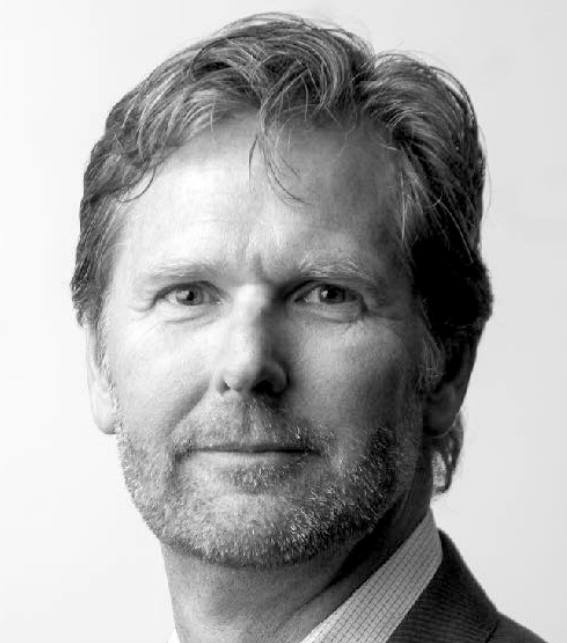
Corporate and institutional venture investor with more than two decades in the field. A Partner and Investment Committee member at Forté Ventures (joined 2012), a multi-stage venture capital firm with offices in Atlanta and Menlo Park, he brings the structural diligence of a professional venture investor to every engagement. He was previously Vice President and Investment Partner at Siemens Venture Capital, the roughly $850M venture arm of Siemens AG. Across his career he has held more than twenty-five years of executive positions with global corporations spanning engineering, product management, and related functions, and he holds an MBA in Marketing from the Cox School of Business at Southern Methodist University. He advises The Brainworks Foundry on capital strategy, investor introductions, and Foundry operations, bringing deep relationships and structural diligence to the Foundry's formation phase.
LinkedInThread archive
Chronological log of milestone posts across X, LinkedIn, Substack, and the blog. Cadence begins at Phase 5; empty state is honest, not fabricated.
Archive populates after first publish. LIVE
Weekly thread cadence begins at Phase 5 per DEV_PLAN. This list reads from the build_in_public table at build time. Currently: 0 entries, honest empty state — no hardcoded placeholders.
Frequently asked
Every numeric statement here is source-linked to the PPM or to the SEC regulation cited. Volker review applies to every Q before production promotion.
A pooled YC post-money SAFE issued by Brainworks Ventures Foundry, Inc. (Delaware C-corp), modified for a pooled vehicle. Cap-only, no discount. Flat $280M post-money cap applied uniformly to every SAFE Investor — no tiers, no commitment-size pricing. Converts at the next priced round into the same security class issued in that round.